




ePropulsion Spirit 1.0 Evo electric outboard motor 1 kW
ePropulsion Spirit 1.0 Evo electric outboard motor 1 kW
Low stock: 1 left
Couldn't load pickup availability
SKU: SE-RRRR-S0
EAN: 6971312631951
The ePropulsion Spirit 1.0 Evo is a quiet, 1 kW electric outboard motor for use on inflatables, RIBs, tenders, sloops, fishing boats, and smaller sailboats, among others. The Evo version supports hydrogeneration: while sailing, the rotating propeller can charge the battery when the required sailing conditions are met.
Choose model
- Current variants are available with top-mount control or side-mount control.
- Choose a version with the integrated 1,276 Wh Spirit battery or without a battery.
- Battery: if you choose "Without battery", the battery is supplied separately and is not included.
- The base price depends on the selected variant. Therefore, please check the selected control and battery above the order button.
- For a steering installation, a suitable steering wheel and steering cable are also required, among other items.
Are you looking for a simpler version with a tiller and without hydrogeneration? Check out the ePropulsion Spirit 1.0 Plus.
Power and application
The 1 kW brushless direct-drive motor is theoretically compared by ePropulsion to a 3 hp gasoline engine. As a practical Marinaut guideline, the motor can bring boats up to approximately 900 kg to cruising speed and lighter boats up to approximately 300 kg towards hull speed. Actual performance depends on the hull, load, wind, current, propeller, and sailing conditions.
For a larger or heavier boat, more power might be more appropriate. Please also take a look at the ePropulsion Navy 3.0 and ePropulsion Navy 6.0 Evo.
Hydrogeneration
At sufficient speed while under sail, the Spirit 1.0 Evo can return energy to a connected ePropulsion battery via the propeller. Yield varies per sailing speed and installation. Consult the manual for the required conditions and settings. Hydrogeneration is a supplement to charging via mains power, solar panels, or a suitable external charging solution.
Official performance with Spirit battery
| Input power | Speed | Runtime | Range |
|---|---|---|---|
| 35 W | 3.5 km/h | 36 hrs 25 min | 129 km |
| 65 W | 4.3 km/h | 19 hrs 35 min | 85.3 km |
| 125 W | 5.6 km/h | 10 hrs | 56 km |
| 250 W | 7.1 km/h | 5 hrs | 35.5 km |
| 500 W | 8.5 km/h | 2 hrs 30 min | 21.3 km |
| 750 W | 9.2 km/h | 1 hr 40 min | 15.3 km |
| 1,000 W | 10 km/h | 1 hr 15 min | 12.5 km |
Factory test with a 12-foot aluminum boat, one person, one Spirit battery, and calm inland water. Speed, runtime, and range may vary in practice.
Marinaut field test with S430
| Power | Measured speed | Practical range |
|---|---|---|
| 100 W | approx. 5 km/h | approx. 65 km |
| 250 W | approx. 6 km/h | over 30 km |
| 500 W | approx. 7 km/h | approx. 18 km |
| 1,000 W | approx. 8 km/h | approx. 10 km |
These values are practical measurements with a Marinaut S430 and do not constitute a guarantee for other boats. With more people, a heavier boat, headwinds, or currents, speed and range will decrease.
Operation and use
- Stepless throttle control forward and reverse.
- Digital display showing power, battery level, remaining runtime, etc.
- Magnetic kill switch and adjustable maximum motor power.
- Optionally compatible with a wireless ePropulsion safety wristband for man-overboard protection.
- Automatic shutdown after prolonged inactivity.
- Direct-drive propulsion without gears for quiet operation.
- Suitable for left- and right-handed operation, depending on the chosen control.
Motor specifications
| Nominal power | 1,000 W |
|---|---|
| Theoretical comparison | 3 hp |
| Input voltage | 39–60 V |
| Motor type | Brushless DC motor, direct drive |
| Maximum efficiency | Approx. 83% |
| Static thrust | 316 N |
| Nominal propeller RPM | 1,200 rpm |
| Cooling | Natural cooling |
| Motor weight | 11.3 kg for the Evo short shaft; version may vary |
| Propeller | 11 × 5.8 inch, 2-blade composite |
| Trim positions | 0°, 7°, 14°, and 21° |
| Tilt angle | 85° |
| Evo shaft lengths | Short shaft and long shaft |
| Hydrogeneration | Yes, under suitable sailing conditions |
Spirit battery
- Capacity: 1,276 Wh lithium-ion polymer.
- Weight: 8.7 kg.
- Floating design: the separate battery has positive buoyancy.
- Standard charging time: approx. 8.5 hours.
- Fast charging: approx. 3.5 hours with the optional fast charger.
- External charging: charging via a suitable solar panel is possible; for external E-series batteries, the appropriate cables and accessories are required.
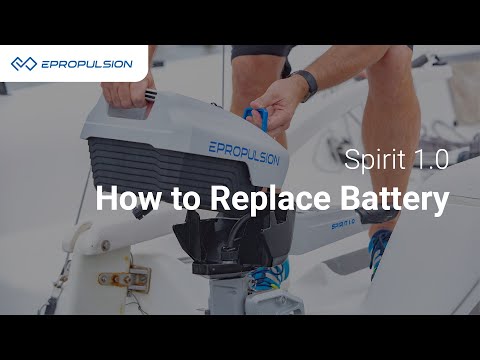
- The battery is easy to remove. A second battery can extend the runtime.
Choose shaft length
- Short shaft: generally for a transom height of 40–50 cm.
- Long shaft: generally for a transom height over 50 cm.
Before ordering, measure the vertical distance from the motor mounting point to the bottom of the boat. The required shaft length may differ from that of a fuel engine. The Evo is not available as an extra-short shaft; that version belongs to the Spirit Plus.
Test reports with the Spirit Plus
The tests and field experiences below were conducted with the ePropulsion Spirit 1.0 Plus. Both the Spirit Plus and Spirit Evo have a 1 kW direct-drive motor and can use the same 1,276 Wh Spirit battery. The Evo additionally features hydrogeneration and other control options. Therefore, the results serve as an indication, but not as a guarantee for every Evo installation.
| Boat | Length | People | Conditions |
|---|---|---|---|
| RU-250 roll-up | 2.4 m | 1 | Cloudy; inflatable hull; dry weight 23.6 kg |
| F-RIB 360 | 3.3 m | 2 | Windy; rigid hull; dry weight 43 kg |
| Gentle 360 | 3.6 m | 4 | Windy; rigid hull; dry weight 85 kg |
| Rigid boat | 3.7 m | 1 | No wind; estimated dry weight 60 kg |
| e.BALIN Tour | 4.3 m | 1 | Windy; dry weight 280 kg |
| Liteboat LiteXP | 5.9 m | 2 | Windy; dry weight 150 kg |
| RS21 | 6.3 m | 2 | Wind force 3–4; dry weight 650 kg |
Watch the test video with the F-RIB 360.
Results from the test reports
- On a Gentle 430 with six people, the motor was experienced as quiet and powerful, with sufficient power for relaxed cruising.
- With an extra-short shaft Spirit Plus, approximately 8–9 km/h at full power and 6.5–7 km/h at about one-third power was reported. The Evo itself is not available as an extra-short shaft.
- On a sailboat of approximately 700 kg, approximately 7 km/h was reported, with fast response and good maneuverability.
- On a Drascombe Lugger, a runtime of approximately four to five hours at about 6 km/h was reported.
These are practical measurements with the Spirit Plus. Speed, runtime, and range differ per hull, load, battery status, wind, current, and sailing conditions.
Documentation and advice
- ePropulsion Spirit Evo manual
- ePropulsion brochure
- Read more about electric boating, speed, and battery capacity
- Calculate the requirements for your own boat
- Trade-in is possible
Need help with motor power, battery, or installation? Contact us for advice.


