


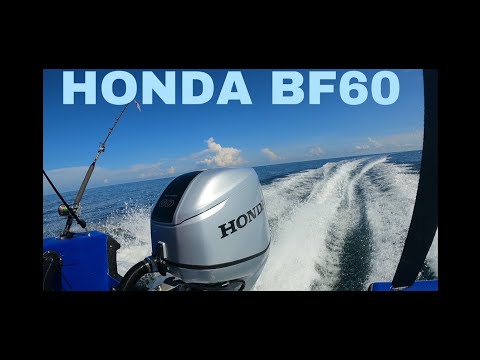
Honda 60 HP outboard motor BF60A LTRU
Honda 60 HP outboard motor BF60A LTRU
Couldn't load pickup availability
BF60 60 hp – 4-stroke engine | 3 cylinders – 998 cm³
- According to boat-fuel-economy.com, full throttle consumption is 17 liters per hour. At half throttle, consumption is estimated at 4.9 liters per hour.
-
A rule of thumb is that for fast boats, you need 1 hp for a total weight of 10 to 20 kilograms. Based on this, this outboard motor is suitable for a total weight of 600 to 1200 kilograms.
For displacement boats, 1 hp per 150 to 200 kilograms is sufficient; then the engine is adequate for 9 to 12 tons of total weight. -
Delicate touch : The optional Trolling Control lets you make fine speed adjustments in 50 rpm increments—between 750 and 1000 rpm—with a simple touch . Very useful when you need precise control for fishing at sea, on a river, or on a lake.
-
Cruise more, spend less : Our unique ECOmo Lean Burn Control system adjusts the air-fuel ratio based on load and speed, so you use less fuel at cruising speed. When your boat is on the plane and has reached cruising speed (in the green range shown above), you can save up to 20% fuel by leaning the air-fuel mixture—and that saves you money.
-
Plug and play : The engine is NMEA2000® compatible, making it compatible with all other compatible electronic devices, such as navigation and fishfinder systems. Engine data such as rpm, temperature, and fuel consumption can be displayed via multifunction gauges.
-
Charged : The high-capacity alternator delivers a solid 22 amps, enough to keep a battery with a 17-amp charging capacity in top condition. And to power all the electronic equipment you have on board.
-
Low friction : The gearbox is extremely fluid and super-smooth. The gears are finely tuned, minimizing friction, contributing to excellent performance and exceptionally low fuel consumption at high speeds.
-
Get started and go : Honda BLAST™ technology with PGM-Fi electronic fuel injection delivers instant acceleration to get the boat on plane as quickly as possible. This is achieved by using even more precise ignition timing, which delivers more torque at low rpm, so you can reach cruising speed very quickly. This system therefore offers you extremely responsive performance and more efficient fuel consumption by very precisely controlling the fuel delivery to the engine.
- 4Front Corrosion Protection: a four-layer coating process that provides protection against UV radiation and salt water. This provides the best protection against the harsh conditions at sea. Four layers of defense: Honda first anodizes the aluminum body with a patented "double-sealing" process. Then, an epoxy primer is applied before the shimmering silver paint is applied. For added UV protection, a topcoat of clear acrylic resin is finally applied. And for added security, a solvent electrode is attached, and all connections are waterproof. Corrosion doesn't stand a chance.
- View here the brochure.
- The Honda warranty covers both manufacturing and material defects during three years from the date of purchase.
- Prices include VAT.
Sailing test review by Boote-Magazine.de in 2020 comparison between Honda, Mercury, Suzuki, Yamaha, Selva und Tohatsu.
The 998cc three-cylinder engine still boasts the largest displacement in its class. Another unchanged trademark is the cylinder head with overhead camshaft and four-valve technology and ECOmo (Economy Controlled Motor). ECOmo monitors and regulates the fuel-air mixture using a lambda sensor. When the boat is on plane and the engine speed is in the green range, ECOmo leans the mixture (more air) and thus reduces pollutant emissions. To generate more thrust and thus get the boat on plane faster, "Blast" automatically advances the ignition timing and enriches the fuel-air mixture. The on-board computer not only searches and finds the correct ignition point but also controls the electronic fuel injection, which calculates the optimal amount of fuel in every situation and determines the perfect moment for injection.
Screw effect
If thrust, rather than top speed, is your top priority, the thrust versions offered by the manufacturers are a good choice. Modified gear ratios and redesigned lower sections allow for the installation of large-diameter propellers with a lower pitch. Essentially, the two together produce more thrust. And not just in theory. We measured the bollard pull, or the pulling force of the drivetrain, on both versions of the Honda BF 60. The "standard version," equipped with a 2.07:1 gear ratio, pulled 2.36 knots (kilonewtons) at 3,100 rpm with the (engine) test propeller (11" x 16"), or in other words, at 241 kg. With the Power Trust gearbox with a 2.33:1 ratio, on which a propeller with a diameter of 14" and only "9" is mounted, the BFP 60 pulled 4.00 knots at 3,950 rpm, or at 408 kg on the electronic scale. This makes it much easier to maneuver heavy boats. The "light" Valiant 550 with Power Trust was a second faster in acceleration over a short distance (0-30 km/h), but was then especially at top speed - far (almost 14 kilometers per hour) behind the standard BF 60. The Honda also achieved the highest speed of 67 kilometers per hour.
Honda's BF 60 alone is a real silent trooper, i.e. an engine that remains below the "pain threshold" of 85 dB/A in this riding range.
Conclusion : The search was for the first of its kind. A performance class with hardly any significant differences in terms of quality, handling, and standard equipment. The Honda is still the test winner, mainly due to its quiet engine.
Speeds
This outboard motor is suitable for water sports; for water skiing, wakeboarding or wakefoiling (for boats with a speed from 20 kilometers per hour for beginners up to 35 kilometers per hour for advanced users).
- With a Valiant's 500 Sailing with a total weight including crew of 600 kilograms you can achieve 60 to 67 kilometers per hour.
- With a Whaly 500 you can reach a speed of over 60 kilometers per hour (see video).
- With a rubber boat, speeds of more than 60 kilometres per hour are achievable.
- With a Bayline 160 speedboat (600 kilograms net) you can sail up to 54 kilometers per hour.
- With the Topcraft 565 with a boat weight of 600 kilograms, you can sail with a 60 hp outboard motor up to a top speed of more than 60 kilometers per hour.
- With the Oud Huijzer 600 tender with a boat weight of 600 kilograms, you can sail with a 60 hp outboard motor up to a maximum speed of 53 kilometers per hour.
- A Maxima 620 Tender (gross weight approximately 1,000 kilograms) sails at a top speed of approximately 45 kilometers per hour.
- With the Lago Amore 633 with a boat weight of 800 kilograms and 4 persons, you can sail with a 60 hp outboard motor up to a maximum speed of 42 kilometers per hour.
-
With the Nautilus 15 RIB with a boat weight of 366 kilograms, you can sail with a 60 hp outboard motor at a top speed of 53 kilometers per hour.
---
Specifications
-
Engine: 4-stroke Water cooling
-
Type 4-stroke: OHC - 3 cylinders
-
Engine capacity (cm³): 998
-
Bore x stroke (mm): 73 x 79.5
-
Full throttle speed (RPM): 5,000-6,000
-
Propeller shaft power (kW (HP)): 44.1 (60)
-
Cooling system: Water cooling
-
Fuel system: PGM-FI (Electronic Fuel Injection)
-
Ignition system: Electronic PGM-IG
-
Starting system: Electric start
-
Exhaust system: Via the screw hub
-
Gear ratio: 2.07
-
Propeller Rotation Direction: Standard
-
Trim: Power Trim & Tilt
- Electric start: Yes
-
Dynamo Output (AMP): 22A
- Charging capacity (AMP): 17A
-
Remote control: Yes
-
Including 5 meter set consisting of
-
tachometer
-
trim meter
-
speedometer
-
voltmeter
-
and fuel tank gauge
-
-
Including Switchbox remote control side mounting
-
Includes 25 liter fuel tank
-
Including aluminium propeller (surcharge for stainless steel €409)
-
Longtail dimensions:
-
Mirror height (mm): 521
-
Dry weight (kg): 107
-
Length (mm): 777
-
Width (mm): 417
-
Height (mm): 1.397
-
-
Remote control surcharge
• Top mounting € 209.00
• Side mounting / Flush mount € 209.00 -
Control stick (surcharge instead of remote control and incl. trolling mode) € 409.00
- Delivery time in consultation. Please contact us by phone at +31(0)24799804 or by email at info@marinaut.nl or via chat (bottom right).
Types
- BF 60 LRTU : A 521 mm tailpiece, a 17-amp battery charger, electric start, and power trim and tilt (allowing you to automatically adjust the engine angle). L: long shaft, R: remote control, T: trim, U: European version
- BFP 60 LRTU : A 531 mm shaft, a 12-amp battery charger, electric start, remote control, power trim and tilt (allowing you to automatically adjust the engine angle), and a P: Power Thrust transmission for heavier boats. L: Long shaft, R: Remote control, T: Trim, U: European version.
- BFP 60 XRTU : A 658 mm shaft, a 12A battery charger, electric start, remote control, power trim and tilt (allows you to automatically adjust the engine angle) and a power thrust transmission for heavier boats. X: Extra long shaft, R: Remote control, T: Trim, U: European version
- The boat's transom height determines the outboard motor's shaft length. Measure from the mounting point of the motor to the bottom. Is the transom height around 43 centimeters? Then you'll need a short shaft. For a length of 51 centimeters, a long shaft is best. You'll need an extra long shaft for a length of 63 centimeters.
Share


