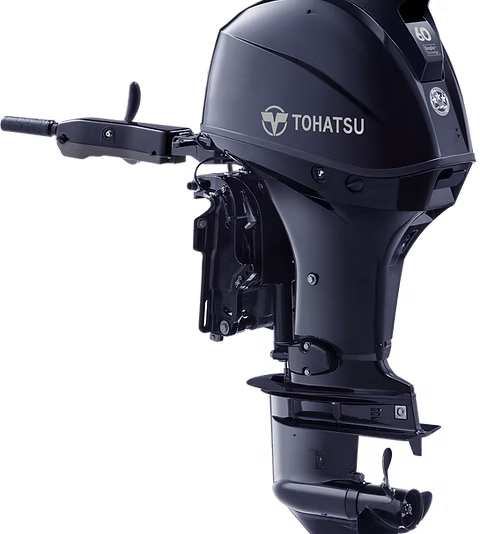
Tohatsu 60 HP outboard motor MFS60A ETL
Tohatsu 60 HP outboard motor MFS60A ETL
Tohatsu MFS60A ETL 4-stroke outboard engine in stock!
With a sleek look, the new MFS60A 4-stroke outboard engine is made with new technologies and features. By using proven technology such as; electronic fuel injection (EFI), dual intake valves, anodized pistons and a modified roller rocker arm, your time on the water will be equipped with smoother and faster acceleration.
This outboard motor is suitable for watersports; for waterskiing, wakeboarding or wakefoiling (for boats with a speed of 20 kilometers per hour for beginners to 35 kilometers per hour for advanced users).
As a rule of thumb, for fast boats you need 1 hp per 10 to 20 kilograms of total weight. Based on this, this outboard motor is suitable for 600 to 1,200 kilograms of total weight.
For displacement boats, 1 hp per 150 to 200 kilograms is sufficient; then the engine is sufficient for 9 to 12 tons of total weight.
-
Test report sea trial 1: Topcraft 565: In the well of the test boat hangs a 60hp Tohatsu, a fine three-cylinder gasoline engine. It is a new model introduced this year and is the lightest in its class with a weight of 98.5 kilograms. This engine is also equipped with the latest gadgets such as EcoMo and Blast. These are features that make the engine run more economically, without loss of power. It is a fine, smooth power source that runs whisper-quiet at idle in the well and looks modern.
On this day with many waves and wind, we recorded a top speed of 43 kilometers per hour. That is a good speed, but this tender will undoubtedly perform better as a displacement tender or fast-sailing when conditions are optimal.
-
Test report Sea Trial 2 Sea trial review by Boote-Magazine.de in 2020 comparison between Honda, Mercury, Suzuki, Yamaha, Selva and Tohatsu.
The slowest, Tohatsu's MFS 60, has great difficulty exceeding 60 km/h. The Honda comes closest to the Mercury (67 km/h).
The sprinters' competition is titled "Upside Down World". Simply the best, the Mercury lags behind in acceleration (0 to 30 and 0 to 50 km/h). Does the high engine suspension, which allows the propeller to be ventilated a little, take its toll here? The winner is Tohatsu, who has no chance at top speed.
Conclusion: The search was for the first among equals. We have found a performance class in which there are hardly any serious differences in terms of quality, operation and standard equipment - this is where Selva and Yamaha score with a portable 25-liter tank. This is reflected in the pricing between expensive (Yamaha) and cheap (Tohatsu), and in the measurement results. Its sprinter qualities, its weight and the five-year warranty speak in favor of the Tohatsu.
The Honda is the winner of the test mainly due to its quiet engine. Tohatsu can therefore be considered the engine with the best price/quality ratio.
Tohatsu MFS 60 A The cheap lightweight from the Far East became the "sprinter king" in the test
-
Test report Sea Trial 2 review 2020 Fishingworld.com.au
The Mad Dog Brute is available in center and side console configurations. The test boat had a center console, a good fit for a boat like this with plenty of room left over for fishermen and other passengers. Typical of a 4.89 meter center console, this boat offers great versatility.
Taking the boat to Broken Bay on a stormy day was a great test and the boat passed with flying colors. The Brute gave a great account of itself as it sailed through oncoming swells at a moderate cruising speed of about 18 knots. The extra high console provided me as the driver with sufficient protection against splashing water and I stayed bone dry.
The boat went about 30 knots at 6000 RPM (56 kilometers per hour) with a good cruising speed of 18 knots at 4000 RPM. You could increase the engine power, but I thought this 60 hp was a good match for the 4.89 with two people on board.
The MFS 60A meets many requirements for anyone looking for a 60 hp four-stroke engine. Weighing only 98.5 kg, the new engine is 15 percent lighter than Tohatsu's previously popular M60C two-stroke engine. That's impressive. It is also 7 kg lighter than its closest competitor.
With the phasing out of old technology two-stroke engines, fisho no longer has to work with heavy or slow four-stroke engines. With models like this, the future looks bright for boaters!
The 3-cylinder 60 is very quiet, economical, powerful and environmentally friendly at idle and on the road.
Features include trolling control at idle speed, a simple freshwater flushing system, multi-function tiller (EFTL), TOCS-on-board communication connectivity (optional).
Optional: TOCS 4.3 inch LCD color screen with information about:
- Engine speed
- Engine operating temperature
- Battery voltage
- Fuel consumption
- Tilt/trim gauge*
- Total engine operating hours in hours
- Total fuel consumption
- Fuel tank level(s)
- Current consumption
- Course/speed
- Various warnings
- Self-diagnosis system
With NMEA2000, J1939 CAN Bus and coupling.
It is also possible to order a set of original Tohatsu analog built-in gauges for the same price; tachometer, speedometer, hour meter, trim gauge, voltmeter and fuel gauge.
Tohatsu says the MFS60A retains many of the proven core values of the MFS40/50A. "However, Tohatsu engineers have introduced a number of interesting "Simpliq technologies" into the new MFS60A, including: three valve intake, roller rockers for friction reduction and anodization along with a unique piston."
It is also a great looking engine and is available in aquamarine or beluga white colors.
Engines in the 60 hp range are a very popular size in Australia, suiting a category of boats we like to use. I have no doubt that the Tohatsu, with its lightweight features, fuel efficiency, quietness and responsiveness, will provide its value for money.
-
Test report 3 sea trial review by tradeboat.com.au
The test was conducted with a Stessco Catcher 449 SC boat with a total weight of 600 kilograms including passengers.- At 1,100 rpm, a speed of 4 kilometers per hour was achieved and a consumption of 2 liters per hour.
- At 3,000 rpm, a speed of 20 kilometers per hour was achieved and a consumption of 5 liters per hour.
- At 4,000 rpm, a speed of 30 kilometers per hour was achieved and a consumption of 8 liters per hour.
- At 6,150 rpm (full power), a speed of 59 kilometers per hour was achieved and a consumption of 19 liters per hour. Source: Tohatsu.com.au.
When Tohatsu released its MFS 50A, it was one of the lightest outboards in its power class. But its native 60 is only 1.5 kg heavier and a whopping 11.5 kg lighter than the Honda-produced BFT 60A it replaced. In fact, the MFS 60A is only 6 kg heavier than the old 798 cc twin-cylinder, oil-injected carbie two-stroke Suzuki DT60C from 1983, an incredible achievement for a three-cylinder four-stroke 60 with fuel injection.
But the way Tohatsu achieved the 9.8 hp (hp) increase from the same displacement MFS 50A was surprisingly simple. Even more incredible is that the MFS 60A outperforms its much larger displacement four-cylinder four-stroke 60 competition.
Tohatsu was very clever in the way it designed its 60. It did not increase piston displacement but increased airflow to the cylinders, effectively reducing the volume of the air intake manifold. The result was faster flowing air. To promote faster flow, the throttle body butterfly valve was made thinner for less air disruption.
Two valves per cylinder were not enough for this increased airflow, so Tohatsu added another intake valve, while also increasing valve lift from 9-9.5 mm. Rollers were added to the rocker arms driven by the single belt-driven overhead camshaft to reduce friction and component wear. The 'squish' area of the piston crowns was enlarged to increase the compression ratio. All these adjustments improve performance without having to opt for a lighter plastic intake manifold, which can deform if the engine overheats.
However, unlike the previous Honda-produced Tohatsu BFT 60A, the oxygen sensor in the exhaust system was removed due to reliability issues. An oxygen sensor measures the density of the burned air/fuel mixture and advances the ignition timing when a higher octane fuel, such as 95 RON premium unleaded, is used. So unlike the Honda engine, there's no point in using 95 RON if 91 can do a similar job. But 95 is a denser fuel, has a longer shelf life, and you're less likely to find it contaminated with ethanol than 91 standard unleaded.
In all other respects, the 60 is the same as its 50 counterpart. The gearbox and gear ratio are the same, as is the 2.4 liter oil sump capacity. The voltage regulated alternator produces up to 21A, four more than the Honda produced 60, but about 5A is used to run the engine management system and the electronic fuel injection, which is reasonably still a throttle body (single point) and not the heavier and more complex multi-point system used in most car engines.
Access to the Powerhead is excellent, with the engine oil sump dipstick to starboard and the filler cap to port, and the bowl-shaped fuel filter and canister oil filter are easy to reach. Nice extras include the separate coils and an excellent sump oil plug for draining engine oil without it dripping down the transom.
Anodes are fitted below and above the anti-ventilation plate and are large enough to be effective.
If necessary, valve clearance is adjusted using a wrench and feeler gauge, not with the complex bucket and shim system that requires camshaft removal on DOHC direct valve actuation competition, which in my opinion is simply cost cutting. Fortunately, Tohatsu has followed Honda's example and not its other Japanese competition.
Maintenance intervals are every 100 operating hours or annually after the first 20 hours or three months. However, if I were doing a lot of trolling, I would change the engine oil and filter every 50 hours or six months to prevent the sump oil from diluting from the combustion chamber gas piston ring. Fresh oil and a new filter are cheap insurance against engine wear problems on the track.
The 60 can be flushed with fresh water without running the engine, but I recommend occasional flushing with muffs to flush away aluminum chloride deposits around the cooling water impeller and thermostat.
ON THE WATER
The demo engine had clocked about eight hours before I tested it, so it wasn't fully run-in, but sufficient to perform limited Wide Open Throttle tests. Unfortunately, due to rather rough test conditions and the noise of the aluminum hull, I could not get accurate decibel or sound measurements. I was surprised that the standard alloy propeller perfectly matched the demo hull, rare when it comes to propping engines over 40 hp.
The 60 started just as quickly and easily as the 50 and had similar vibration levels from trolling to WOT and, provided the anti-ventilation plate remained submerged, reverse power was good, handy for getting out of shallow water in reverse. It handled the rather hefty Mad Dog 489 Brute center console better than I expected and was able to plane the hull well under where maximum torque is developed. I've always believed that for good planing with fuel efficiency, plus less engine load and wear, an engine should plane a hull at rpms below maximum torque, and the 60 planed us at 1000 rpm below the torque peak. Even when cruising, it was close to the maximum engine efficiency band.
Through tight turns with the leg trimmed in, there was no propeller ventilation and the alloy propeller was a little harder than I expected. In engines under 100 hp, alloy props are so good these days that there is rarely a need for stainless steel. Even at full power in a straight line with the transom trimmed well out, there was no sign of prop blowout. The standard power trim worked quickly and quietly.
What did surprise me was the overall performance of the engine. Long ago, in 2004, I tested an early fuel-injected Yamaha F60C on a Horizon Sea Breeze 4750 bowrider; swinging a 13-inch pitch alloy propeller (for a 1.85:1 gear ratio) and pushing a total of 800 kg, the WOT average was 27kt (50 kilometers per hour) at 5650 rpm with 19.2 liters per hour consumption. I didn't expect the MFS 60A to perform so well, but it left the Yamaha behind.
Actually, only the MFS 50A came close. On a Clark 435 center console I tested in 2014, swinging the same prop and pushing a total of 750 kg, it averaged 30.5 knots and 16.8 liters per hour at 6300 rpm, just shy of where the rev limiter kicked in. But the 489 Brute is a much more voluminous hull compared to both the Clark and Horizon hulls.
THE COVER
Tohatsu has overturned the old adage "there is no substitute for displacement" when it comes to mid-range four-stroke outboards. Its lightweight 60 makes repowering easy, as it is suitable for a wide range of hulls.
-
More speeds
- With a Whaly 500 you can reach over 60 kilometers per hour.
- With a dinghy, more than 60 kilometers per hour is achievable.
- With the Topcraft 565 with 600 kilograms of boat weight, you can sail with a 60 hp outboard motor up to a maximum speed of over 60 kilometers per hour.
- With the Riomar 515 sloop with 370 kilograms of boat weight, you can sail with a 60 hp outboard motor up to a maximum speed of 55 kilometers per hour.
- With a Bayline 160 speedboat (600 kilograms net), you can sail up to 54 kilometers per hour.
- With the Oud Huijzer 600 tender with 600 kilograms of boat weight, you can sail with a 60 hp outboard motor up to a maximum speed of 53 kilometers per hour.
- With the Nautilus 15 RIB with 366 kilograms of boat weight, you can sail with a 60 hp outboard motor with a maximum speed of 53 kilometers per hour.
- With the Tridente 20 with 580 kilograms of boat weight, you can sail with a 60 hp outboard motor with a maximum speed of 50 kilometers per hour.
- With a 5.5 meter speedboat with 1,000 kilograms of boat weight, you can sail with a 60 hp outboard motor with a maximum speed of 50 kilometers per hour.
- With the Dutch Runabout 22 speedboat/sloop of 6.5 meters with 670 kilograms of boat weight, you can sail with a 60 hp outboard motor with a maximum speed of approximately 50 kilometers per hour.
- With the Elegance 635 tender, you can sail with a 60 hp outboard motor with a maximum speed of 50 kilometers per hour.
- With the Chaloupe 610 tender with 500 kilograms of boat weight, you can sail with a 60 hp outboard motor with a maximum speed of 45 to 50 kilometers per hour.
- With the Primeur 610 tender with 780 kilograms of boat weight, you can sail with a 60 hp outboard motor with a maximum speed of 45 kilometers per hour.
- With the 4 Family 630 tender with 450 kilograms of boat weight, you can sail with a 60 hp outboard motor with a maximum speed of 45 kilometers per hour.
- A Maxima 620 Tender (gross approximately 1,000 kilograms) sails with a top speed of approximately 45 kilometers per hour.
- With an Aqua 24 700 T7 tender with 900 kilograms of boat weight, you can sail with a 60 hp outboard motor up to a maximum speed of 45 kilometers per hour.
- With the Reitdieper 630, Reitdieper 634, Reitdieper 635, Clever 63, Lago Amore 633 with 800 kilograms of boat weight and 4 people, you can sail with a 60 hp outboard motor up to a maximum speed of 42 kilometers per hour.
SPECIFICATIONS
- Power 60 hp
- Lubrication 4-stroke
- Weight 110 kilograms
- Starting Electric
- Steering typeRemote control or tiller
- Gear leverForward - Neutral - Reverse
- Fuel systemInjection
- Number of cylinders 3
- Displacement 866 cm3
- Maximum power 44 kW
- Full throttle operating speed 5000-6000 revolutions per minute
- Bore x stroke 70x75 mm
- Trim/tilt method Powertrim - Manual trim/tilt
- Shaft length L (20'' = 51 centimeters)
VERSIONS:
-
MFS60AETL: E: electric start, T: power trim and tilt L: Long shaft
For remote control: steering wheel control (both single cable and hydraulic).
With powertrim and tilt, you can optimize the tilt angle of the motor at the push of a button. The trim gauge quickly shows you if the motor's angle is correct. This allows for faster acceleration, smoother, faster, more economical, more stable, and most importantly, safer sailing. Also handy for trailering. - MFS60AWETL: E: electric start, T: power trim and tilt L: Long shaft W: color Beluga White.
- MFS60AEFTL: E: electric start, F: tiller, T: power trim and tilt L: Long shaft
-
MFS60AWEFTL: E: electric start, F: tiller, T: power trim and tilt L: Long shaft W: color Beluga White.
with Big Multi Tiller B handle (see images). This provides electric start and power trim for the outboard motor without requiring a steering function with remote control.- Ergonomically designed shift lever.
- Longer Throttle grip with 110 degrees rotation for maneuverability
- Throttle Friction function for fine adjustment of tiller comfort
- Steering Co-Pilot for steering control.
- Warning lights, key switch, and tilt and trim switch (in the grip) easily accessible.
- Available in Aqua Blue (Article number 3KYQ63000-7) or Beluga White (Article number 3KYW63000-4). -
Included at Marinaut:
-
Rigging cord kit B standard vertical mounting panel without control box/remote control (article number 3YU-84556-1).
- tachometer*
- trim gauge**
- wiring harness
- ignition switch
- kill switch
- communication cable kit.
-
or upon request Side mount kit B Side mount control box with mounting kit, tachometer, trim gauge, wiring harness with ignition switch and kill switch, communication cable kit (article number 3UH-84555-1).
- or Big Multi Tiller B handle
- propeller (standard 11.1 diameter, 14 pitch; other pitch upon request).
- 24 liter fuel tank.
- engine oil.
-
delivery inspection.
- Trim Gauge* (2" diameter) shows the engine angle for optimal performance and efficiency. Features a domed lens to minimize glare in direct sunlight, a fog and scratch resistant coating, and a chrome bezel.
- Tachometer** with a speed of 7,000 rpm (10 cm diameter) has a chrome bezel and is illuminated for good visibility in the dark. Features a domed lens to minimize glare in direct sunlight and a fog and scratch resistant coating. The tachometer informs about possible problems, such as low oil pressure, a nearly empty battery, and overheating, via the built-in warning lights.
-
Rigging cord kit B standard vertical mounting panel without control box/remote control (article number 3YU-84556-1).
- Excluding: starter battery 12 Volt minimum 70Ah / 20HR and 512 CCA.
Advantages of Tohatsu 60 hp 4-stroke
- Best power-to-displacement ratio in its class.
- Best power-to-weight ratio in its class.
- Sleek design with monochrome tilt lever
- SOHC with unique 9-valve design
- Excellent fuel economy. Fuel consumption at full power is 19 liters per hour.
- Lightest weight in its class, only 98.5 kg.
High performance and easy operation
- Electronic fuel injection
- Digital CD ignition system for faster starting
- High output 21 amp alternator
- New and improved gearbox with lower gear ratio for more torque at low RPM
- Adjustable steering friction and trim tab for reduced steering effort
- Power trim & tilt
Basic principles for user-friendliness and reliability
- Through-prop exhaust for a quieter ride
- Built-in freshwater flushing system for easy routine flushing
- Variable idle speed control from 650 to 950 rpm
- A camshaft-driven trochoid oil pump ensures a long life for critical engine components
- Stainless steel lining of the water pump housing for excellent durability
Warning & protection
- Low oil pressure warning (visual and audible)
- Overheating warning (visual and audible)
- Battery voltage warning (visual only)
- Start-in-gear protection for safer engine starting
- Safety lanyard (an essential protection feature standard on all Tohatsu outboard motors)
- Over-rev limiter
FEATURES
SOHC 9-valve and roller rockers
SOHC with unique 9-valve design with roller rockers ensures minimal friction and provides faster throttle response, more durable against wear.
Multifunctional tiller is available on certain models.
The multifunctional tiller features an ergonomically designed shift lever for easy and convenient shifting and a longer throttle grip with 110 degrees rotation for easier maneuvering. All controls on the new multifunctional tiller are conveniently located on the handle for easy access and control. More specifically, the gear lever, throttle, trim switch, safety lanyard, TLDI® warning lights, and electric start key switch are all integrated into the tiller.
Variable idle system
allows adjustment of trolling speed (RPM) in four levels from 650 rpm to 950 rpm (100 rpm each) using the key switch.
Built-in freshwater flushing system
Standard built-in freshwater flushing system simplifies routine flushing of the engine.
Audiovisual warning system
The tachometer informs the operator of possible problems, such as low oil pressure, a low battery, and overheating, via the built-in warning lights. (For models equipped with a tachometer)
Trim gauge
Trim gauge (2" diameter) shows the engine angle for optimal performance and efficiency. Features a domed lens to minimize glare in direct sunlight, a fog and scratch resistant coating, and a chrome bezel.
Tachometer
The tachometer with a speed of 7,000 rpm (10 cm diameter) has a chrome bezel and is illuminated for good visibility in the dark. Features a domed lens to minimize glare in direct sunlight and a fog and scratch resistant coating.
The tachometer informs the operator of possible problems, such as low oil pressure, a low battery, and overheating, via the built-in warning lights.
THAT'S WHY TOHATSU
- Tohatsu from Japan has existed for over 100 years and produces more than 200,000 outboard motors per year. TOHATSU is the largest outboard motor manufacturer in the world.
- Tohatsu has more than 10 percent market share in the Netherlands and is growing fastest in market share in the Netherlands. For models up to and including 30 hp, it already has more than 20% market share!
-
Did you know that Mercury even has outboard motors up to 30 hp manufactured by Tohatsu? The only difference is the cowl and the price.
The Tohatsu BFT models from 150 hp are rebranded Hondas since 2014. So you get a reliable Honda engine for a Tohatsu price.
-
The Tohatsu engines have the highest quality and a lower price than other A-brands. Tohatsu is also the only brand that exclusively produces outboard motors, so it has truly specialized.
- Tohatsu pays great attention to the appearance of its outboard motors, and this is reflected in this model. The look is tough and robust. Under the beautifully streamlined cowl, you will find the trusted Tohatsu technology, developed for years of boating pleasure with minimal maintenance.
- The Tohatsu engine is user-friendly in all respects. For example, the oil filter is positioned so that you can easily replace it yourself. The lubrication of your outboard motor is optimal thanks to the generous oil reservoir. By using the proven Tohatsu electronic injection system, your engine starts smoothly and the throttle response is quick. The RPM can be smoothly controlled.
-
Your newly purchased Tohatsu outboard motor comes with a generous 5-year full factory warranty.
-
Tohatsu always performs well in comparative tests.
- Read the test reports for, among others, the 15 and 30 and 60 hp engine. Tohatsu is the price-performance winner according to Boote Testen.
- The ANWB 'Waterkampioen' also conducted an Outboard Motor Test. The Tohatsu 6 hp emerged as the winner, based, among other things, on weight, noise, and ease of use. According to the ANWB, buying a Tohatsu 6 hp outboard motor is the best choice.
- Boote-Magazin.de also tested the Tohatsu MFS115 A: impressive result due to the best torque-to-weight ratio and higher top speed. Thanks to its small displacement, the Tohatsu is also extremely fuel-efficient.
- Most models are available from stock!
That's why Tohatsu is the best outboard motor.
Tohatsu pays great attention to the appearance of its outboard motors, and this is reflected in this model. The appearance is tough and robust. Under the beautifully streamlined cowl, you will find the trusted Tohatsu technology, developed for years of boating pleasure with minimal maintenance. The engine is user-friendly in all respects. For example, the oil filter is positioned so that you can easily replace it yourself. The lubrication of your outboard motor is optimal thanks to the generous oil reservoir. By using the proven Tohatsu electronic injection system, your engine starts smoothly and the throttle response is quick. The RPM can be smoothly controlled.
WARRANTY & DELIVERY TIME
Your newly purchased Tohatsu outboard motor comes with a 5-year full factory warranty. This gives you solid certainty for carefree boating. You will receive the warranty certificate with your purchase. Technical defects that occur within the warranty period and fall under the warranty conditions will be remedied free of charge.
Low stock: 1 left
Couldn't load pickup availability
Share