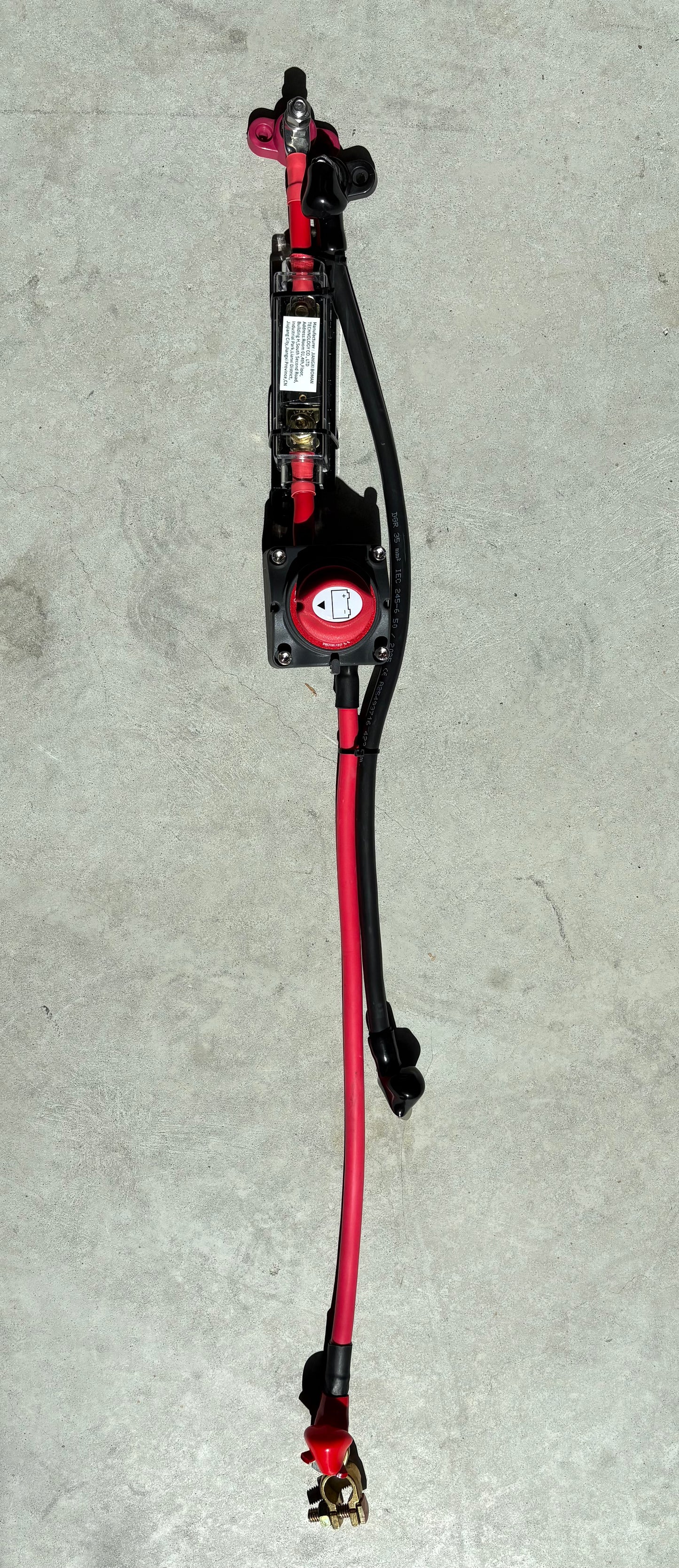
A safe power supply for your boat starts with reliable battery connections. These battery terminals for starter batteries provide essential protection through corrosion-resistant contacts and secure cable connections.
The 35 mm² battery cable ensures optimal power transfer without heat buildup, while the ANL fuse in a transparent holder protects your electrical system against overloads and short circuits.
The main battery switch with battery terminal covers prevents accidental short circuits or leakage current and makes maintenance safer.
This complete system minimizes the risk of electrical faults, fire, and damaged equipment — essential for safe boating.
Set consists of
- 2 battery terminals for starter battery.
-
50 centimeters of 35 mm² thick battery cable.
- Thanks to the double insulation layer of PVC and NBR PVC, this cable is durable and resistant to wear, oil, and corrosion.
- Exceptional flexibility: With a Class 6 copper conductor, this cable is extremely flexible, making it easy to install in tight spaces.
- Wide temperature range: Performance guaranteed from -40°C to +70°C, ideal for both cold and warm environments.
- Double insulated for maximum safety, oil-resistant, and highly flexible (class 6). Complies with fire safety standard IEC 60332-3-24.
- Suitable for current up to 150 A continuous and 350 A peak load. Therefore for electric boat motors up to 1,800 W / 12 V, 3,600 W / 24 V or 7,200 W / 48 V.
- Heat shrink tubing mounted on the battery cable. To prevent electrolytic corrosion and short circuits, and for strain relief and mechanical strength.
- Equipped with protective battery terminal covers.
- Solid cable lug terminals with M10 eye.
- ANL fuse 200 A for short-circuit protection. A 200 A ANL fuse in combination with a 35 mm² cable is a powerful and safe configuration for most common outboard motors up to 150 hp. Because an ANL fuse is "slow-blow," it can handle the short, high peak current of the starter motor without blowing immediately. Also suitable for electric boat motors up to 1,500 W / 12 V, 3,000 W / 24 V or 6,000 W / 48 V.
- Transparent ANL fuse holder.
-
Solid main battery switch up to 48 V. With an easy to use ON/OFF switch. ON (green) stands for a closed circuit and OFF (red) stands for an open circuit. Suitable for 275 A DC continuous, 455 A DC intermittent (5 minutes), 1250 A DC cranking (10 seconds), and voltage: 6 V to 60 V DC;
Legal information
The Recreational Craft Act (which in the Netherlands follows the European RCD - Recreational Craft Directive 2013/53/EU) imposes strict requirements on the electrical installation on board. Although the law itself often speaks in general terms about "safety" and "preventing fire hazards," the concrete implementation is determined by the ISO 10133 standard (for DC installations).
Below you can see how your configuration (as shown in the image) scores on the legal/normative requirements:
1. The Main Battery Switch
-
Legally required: Yes. In accordance with ISO standards, every battery bank must be equipped with a main switch in the positive lead to be able to completely de-energize the installation when at rest or in an emergency.
-
Location: It must be placed as close as possible to the battery and be easily accessible.
2. The ANL Fuse
-
Legally required: Yes. Every circuit must be protected against overload and short circuit.
-
Distance: The fuse must be placed within 20 cm to 180 cm of the battery (depending on whether the cable is in a conduit). For a boat, "as close as possible to the power source" is the rule of thumb to minimize unprotected cable runs.
3. The Battery Terminal Covers and Insulation
-
Legally required: Yes. ISO 10133 requires that "unprotected conductive parts" (such as battery terminals and connection bolts) must be shielded to prevent accidental short circuits caused by dropped tools or shifting objects.
-
By placing the battery terminal covers on the bolts of the fuse holder and switch, the requirement to insulate "exposed live parts" is met.
4. Cable Diameter 35 mm²
-
Legally required: The law stipulates that cables must be able to carry the expected current without overheating.
Important points for inspection:
-
Color coding: Red for positive is the standard.
-
Fastening: Cables must be clamped every 30 to 40 cm to absorb vibrations.
-
Battery stability: The battery itself must be securely fastened (should not move more than 10 mm) in a battery box or with tie-down straps.
Conclusion: The setup with a switch, fuse, and covers is not only wise, but indeed legally necessary for a safe installation on a recreational craft.
Advice and ordering
Have the cable set tailored to your installation. Provide the motor and battery type, system voltage, required cable length, and the existing protection.